Assets UNSCRIPTED | Episode 9 | Berend Booms - IFS Unleashed Recap
This episode is a little different. No guest. Just Berend Booms, a solo mic, and the notes he nearly lost when his phone got stuck in a boot loop midway through the week.
What follows is his recap of IFS Unleashed 2026 - structured, as promised, around five T’s and five I’s.
The Five T’s
Trust
Mark Moffat opened his keynote with a line Berend wrote down immediately: everything has changed. It’s the kind of statement that usually washes over you at these events. But the follow-up stuck: the industrial climate is volatile. Geopolitical pressure, supply chain disruption, rising operational complexity, it’s all eating into margins and raising the bar for what good operations look like.
Against that backdrop, Moffat made a point about AI that’s deceptively simple. If you can’t trust it, you won’t use it.
For asset management, that cuts deep. These are expensive, mission-critical assets. If any layer of technology fails to earn the trust of the person running the machine, the technician maintaining it, or the boardroom planning investment around it, adoption stalls. Every time. Berend observed one speaker describe a technician standing arms crossed, telling them AI wasn’t needed, then spending 40 minutes on a task that could have taken five. For that person, seeing is believing. Tangible outcomes are what moves the needle.
There was also a question on stage that Berend hasn’t quite let go of: should you be able to buy a seat for your robot? Joe Marbella of Southwest Airlines raised it in the context of robotics at trade events. It sounds like a joke, but it opens something bigger, why do we keep designing robots to look, move and speak like humans? Berend’s read: trust. Familiarity lowers resistance.
Time
Two completely different stories about time landed in the same episode.
The first was the Siemens partnership at IFS, AI as a time-saving tool, automating repetitive admin and giving teams back hours they can spend on higher-value work. Every hour not spent on paperwork is an hour that goes back into the operation, especially valuable when human expertise is becoming scarcer.
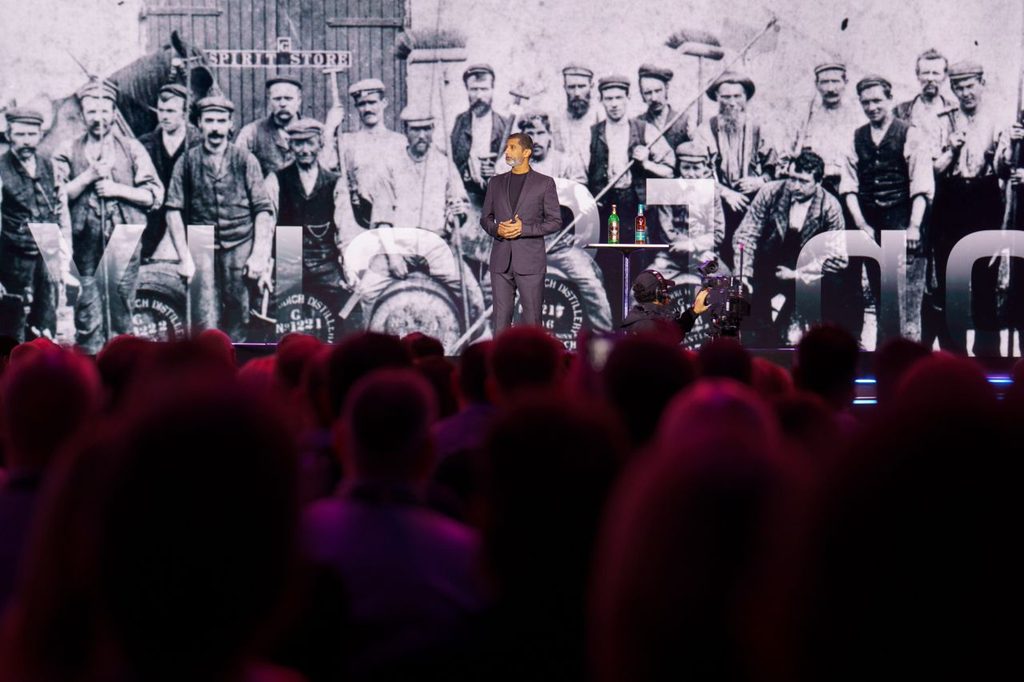
The second was Badi Narasimhan from William Grant & Sons, and it was Berend’s favourite moment of the week. At a whiskey distillery, some expressions sit in casks for decades before they’re considered ready. Time isn’t a pressure. It’s not a KPI to deliver against. It’s part of the strategy. You account for it. You take enough of it to get things right.
In an industry where mean time to repair and time to value dominate every planning conversation, that reframe landed hard.
Tempo
IFS sponsors the Cadillac Formula One team. On the face of it, it’s a great story about a challenger making it onto the biggest stage in motorsport. But Berend sees it alongside William Grant & Sons as two versions of the same discipline: planning far ahead, just at wildly different speeds.
Moffat’s personal motto - speed is life - sits in interesting tension with warnings from Anthropic CEO Dario Amodei that AI is moving faster than we can govern or audit. IFS CTO Vibes Kumar addressed this head-on in a panel: how do you keep the brakes off while keeping the safeguards up? Berend doesn’t have a clean answer. He does think it’s the right question.
Talent
The skills gap has been a fixture of asset management conferences for years. The numbers aren’t getting easier: US manufacturing alone could need 3.8 million workers by 2033, with up to 1.9 million of those jobs potentially going unfilled.
Pedro Buhigas, CIO of Cote Gas, spoke about deploying IFS Loops agents for materials replenishment and reported an 85% efficiency gain. That’s significant. But Berend’s view is that agents don’t solve the skills crisis. They help bridge part of the gap.
The harder problem is tribal knowledge. A 30-year veteran on the plant floor can hear a bearing fail, smell something wrong, sense a vibration that’s slightly off. They’re already three steps ahead. How do you encode that? How do you get someone two months into the job to the same baseline?
Joe Marbella also spoke about attracting young people into skilled trades. Berend’s take: that next generation expects mobile-first, easy-to-use, readily available tools. If the technology feels like 2005, they won’t stick around.
Teamwork
Tom Brady sat down with Jake Humphrey on the Unleashed stage, and it turned out to be one of the better interviews of the week. Brady talked about his approach to showing up in training, not focused on himself, but on finding common ground with every teammate. What do they care about? What are they working towards? Where are they in their career?
His point was that a quarterback, however good, can’t do it alone. Football is a team sport. So is asset management. Every function, every role, every individual has to do their part.
Two quotes Berend wrote down:
“I haven’t failed. I have just found 10,000 ways that don’t work.” (Thomas Edison, via Brady.)
And Brady’s own: “If all you ever do is all you’ve ever done, all you’re going to get is all you’ve ever got.”
Both speak to the mindset you need if you want to turn AI pilots into something that actually sticks.
The Five I’s

Intelligence
IFS Intelligence was the headline product launch of Unleashed. At its core, it acts as an intelligence layer across your operational tech stack, surfacing insights from your data through conversational interfaces, then feeding those insights back into your ERP, EAM, or digital twin as targeted actions.
The part Berend found most interesting wasn’t the insight generation. It was the action. You can have all the data in the world, but if those insights have nowhere to land, nothing changes. IFS Intelligence routes the output back into the systems that actually do things, purchase orders, scheduling, crew deployment. That’s where it starts to matter.
Chamath Palihapitiya made an observation that added nuance here: AI is currently very good at encoding procedural knowledge, the “how we do the thing” layer. It’s far less effective at encoding tribal knowledge, the judgment, the taste, the human experience that makes the difference between a good decision and a great one. That’s the part you shouldn’t try to automate. That’s the part you post-train on, fine-tune around, and keep firmly in human hands.
Investment
Palihapitiya was also Berend’s favourite speaker of the event, partly because he wasn’t avoiding the uncomfortable parts of the AI story.
His view: most organizations haven’t actually seen a return on their AI investment yet. There’s a line he drew between breathless speculative investment and companies doing the real work responsibly. As cloud infrastructure absorbs more and more of the world’s electricity, he put the US energy deficit at six California's’ worth, the cost of running AI is going to increase. His advice to large enterprises: get into the energy game. Generating your own power may stop being a nice-to-have and become a strategic necessity.
Integrity
A line that Berend noted mid-week: machines may take the action, but you own the outcome.
Satya Nadella was quoted on stage making the same point: we cannot outsource responsibility for what a model does on our behalf. Whatever guardrails are in place, whatever speed the operation runs at, there is always a human who is accountable for the result. That’s not going to change.
Berend also raised a question he’s been sitting with: how do you treat your AI? Are you directive, dismissive, polite? He’s not raising it to be philosophical, he’s raising it because how we interact with these systems tells us something about how we see them, and that shapes how we integrate them into the work.
Insincerity
A gentle frustration, shared honestly. At almost every industry event, someone says it’s all about the people or people are our most important asset. Berend doesn’t disagree with the sentiment. He just finds it more powerful when it’s demonstrated than announced.
Brady put it simply: your actions reflect what your priorities are. If people genuinely matter, it shows up everywhere, in investment decisions, in how you design tools, in how you develop and retain staff. It’s easier to say from the stage than to do in the field.
There’s also a claim that’s been circulating, that the way we work has changed forever. Berend’s pushback: asset management is still rooted in the physical world. When a cooler breaks at 2am, you still need someone to show up and turn a wrench. The opportunity isn’t to replace that. It’s to cut the drudgery, the admin, the planning friction and give people who are excellent in the physical world the time to do what they’re actually there for.
Innovation
The final I came from a field service breakout session hosted by Sarah Nicastro. Mark Brewer introduced her with a slight pause, she’s from the Future of Field Service, that made it briefly sound like she’d arrived from the future itself. Berend ran with the idea.
But Sarah’s point landed regardless of the introduction. Digital sophistication must not come at the cost of humanity. Service is a people business. The technology changes what work looks like. It shouldn’t change whether people are at the centre of it.
Especially now, with the workforce challenges Berend outlined under Talent, investing in people isn’t just the right thing to do. It might be the smartest play available. That’s how you attract the next generation, develop them, and hold on to the skills you’re going to need when industrial AI moves from pilot to practice.
These were Berend’s five T’s: Trust, Time, Tempo, Talent, Teamwork and five I’s: Intelligence, Investment, Integrity, Insincerity, Innovation.
A week at IFS Unleashed never leaves you short of things to think about. Some of the threads from this episode will come back in future episodes and articles. For now, this is where the notes end, rescued, just about, from a phone that had other ideas.

Assets UNSCRIPTED is the Future of Assets podcast series hosted by Berend Booms. Each episode brings together leaders from across asset-intensive industries for authentic, unscripted conversations on the ideas, challenges, and innovations shaping the future of asset management. New episodes are published on YouTube, Spotify, and Apple Podcasts.